Social Media is one of the most impactful mediums in the world right now. It has the power to connect people, aiding the spread of ideas and opinions. However, many see this as an opportunity to influence people’s views and therefore real-life outcomes such as elections. Most notably the Russians who allegedly helped Trump win his Presidential campaign by influencing US voters via social media. (Abeshouse, 2018)
Social Media companies now have the responsibility to protect their users. This has resulted in each platform creating their own set of rules to allow who can use the site and who can’t. This is to protect users who may be targeted with hate online and to make sure that content displayed to users is fair and not “fake news”.
This is controversial as although it is argued that these people are often being banned for being hateful, Americans believe this denies them of their right to free speech and expression. Many believing they are simply giving their opinions on controversial topics such as immigration or the rights of transsexual people. Twitter for example have been accused of being biased against the views of more conservative users who’s views on such topics are seen as being hateful (Anon., 2019).
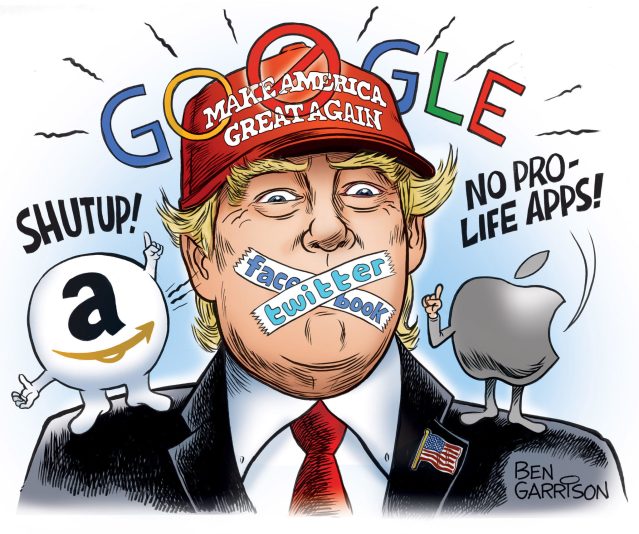
However, the introduction of these rules has resulted in a boundary to social media as some people may not be able to use it based on which side of the political spectrum they lie on. An example being the controversial social media accounts associated with far-right political organization Britain First were removed from Facebook in March 2018. This was only a few months after having anti-Islam tweets being retweeted by Trump himself (Hern & Rawlinson, 2018). Also, of 22 high profile political twitter users that have been suspended, 21 of them are supporters of Donald Trump, this also showing that social media outlets seem to be more partial to certain political views (Hanania, 2019).
The problem with this is that the social media platforms create their own rules and don’t draw the clearest lines. There have been reports of users having their accounts suspended for simply tweeting the words “learn to code” to out of work journalists. These words were advice these journalists similarly gave miners who had just lost their jobs. This came under criticism as it isn’t clear what rules are being broken here and why (Athey, 2019).
So now in a world where people can have their access revoked to a platform supposed to give a voice to everyone, for having the wrong views. The platforms also having the power to decide who it is with the wrong views. This raises the question whether social media companies should have to power to create their own rules, or if we’ll see some kind of international standard set in the future.
Bibliography
Abeshouse, B., 2018. Russia
used all major social media platforms to aid Trump: report. [Online]
Available at: https://www.aljazeera.com/news/2018/12/russia-social-media-network-aid-trump-election-181217191309002.html
[Accessed 1 April 2019].
Anon., 2019. US lawmaker sues Twitter, alleging
anti-conservative bias. [Online]
Available at: https://phys.org/news/2019-03-lawmaker-sues-twitter-alleging-anti-conservative.html
[Accessed 1 April 2019].
Athey, A., 2019. TWITTER RESTRICTS PEOPLE WHO
TWEET ‘LEARN TO CODE’ — EVEN IF THEY AREN’T ENGAGING IN HARASSMENT. [Online]
Available at: https://dailycaller.com/2019/02/13/twitter-restricts-learn-to-code/
[Accessed 1 April 2019].
Hanania, R., 2019. It Isn’t Your Imagination:
Twitter Treats Conservatives More Harshly Than Liberals. [Online]
Available at: https://quillette.com/2019/02/12/it-isnt-your-imagination-twitter-treats-conservatives-more-harshly-than-liberals/
[Accessed 1 April 2019].
Hern, A. & Rawlinson, K., 2018. Facebook bans
Britain First and its leaders. [Online]
Available at: https://www.theguardian.com/world/2018/mar/14/facebook-bans-britain-first-and-its-leaders
[Accessed 1 April 2019].

 Beyond The Border